Showing posts with label transit. Show all posts

Monday, 8 June 2015

Ontario's Common Sense Revolution at 20: A Look Back [cross-post]

By Joe Fantauzzi
ninetytwopointeight@gmail.com

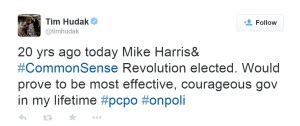
Today marks 20 years since the Progressive Conservative Party foisted its so-called "Common Sense Revolution" on Ontario.
Former PC Ontario leader Tim Hudak took to Twitter this morning to extol the virtues of this full-throated neoliberal experiment, declaring it "the most effective, courageous gov[ernment]" in his lifetime.


Some remember those days differently. Here are a few highlights of the "Common Sense Revolution" (1995-99) and the subsequent "Blue Print" era (1999-2003).
Many Ontarians are still dealing with the aftermath of heartless program cuts initiated by the PC regime and the general neoliberal political culture that continues today at the provincial, federal and municipal (in Toronto) levels of government.
This is not a day to celebrate.

Monday, 11 August 2014

Election 2014: A Lost Opportunity To Push For A Real Deal For Cities

By Joe Fantauzzi
ninetytwopointeight@gmail.com

The Toronto municipal election has been dominated by coverage of issues such as transit, taxes and housing. Each of these issues unto themselves are important and crucial to a healthy, viable city.

However, this election is turning out to be a lost opportunity for Toronto's candidates to call on Queen's Park to loosen the political strings and establish a Real Deal For Cities that locates our metropolis as a viable, respected entity ─ instead of a so-called "creature of the province."

This analysis doesn't call for an amendment to recognize Toronto and other cities as third levels of government in the Constitution Act, 1982, but merely a push ─ a needling ─ of Queen's Park, and by extension Ottawa, to devolve new spending authorities and building mechanisms to Toronto within the framework of Section 92.8 of the Constitution, which as the sidebar to this blog notes, grants municipalities wholly to the provinces as if they were some sort of colony.

Rejecting the conservative and paternal framework of the current province/city arrangement isn't revolutionary. In fact, as Warren Magnusson tells us in "Are Municipalities Creatures of the Provinces?" while municipalities are generally seen to be at the bottom of the constitutional heap, many cities predate the provinces to which they are seen to be subservient.¹ Toronto is one of those cities: "a relatively late creation...(it) had been around in one guise or another for 74 years at the time of Confederation."² In other words, the historical record simply doesn't back up the creatures of the provinces mantra.

The neoliberalism (read: public private partnerships or outright privatization) of the modern age may also, perhaps ironically, back the argument for more official authority at the city level and a divesting of responsibility from the provincial and federal levels. That the federal and provincial governments are seen to have consumed all available sovereignty ignores the idea that many services are now "provided by agencies at one remove from government: private firms operating under service contracts, non-profit organizations with multiple funding sources and missions of their own, public authorities with their own boards of directors, regulatory boards, advisory agencies, joint ventures and all manner of other bodies"³. The provinces do not have "command" over what happens in the day-to-day operations of these agencies other than perhaps funding and defunding decisions, which some agencies may be able to get around depending on their revenue stream(s). The point here of course is that today, there aren't merely two levels of governance at play vis-à-vis services provided to Canadians ─ despite what the Constitution Act says about which level of government is "responsible" for the delivery of service. There are already more players than the province and Ottawa; why can't Ontario grant more power to the local council closest to those agencies making on-the-ground decisions such as the power to fund and defund? Or even the power to abolish and or assume control of?

In fairness, it has been tried before. The much-discussed New Deal For Cities was a hot topic in the early 2000s, culminating locally in the new City of Toronto Act, 2005. The truth, of course, is that the 2005 Act was merely an update to the very Act that precipitated the amalgamation of Toronto in 1998.⁴ The irony of using a tool that led to five municipalities (North York, Scarborough, East York, York and Etobicoke) disappearing overnight to somehow empower the city through new spending measures is rich. 

While the city now has powers of taxation such as the vehicle registration tax and the land transfer tax, substantive taxation powers, such as income tax and sales tax, remain controlled by senior levels of government. These are powers best managed by the city. People work in the city and buy things in the city. It is in the city and to the city that they should pay their taxes.

There is still time for the leading mayoral contenders to take up Toronto's cause. But it is looking less and less likely that such a task, one so clearly connected to the essence of what Toronto is to its residents, will be even discussed, let alone made an item of debate during this election campaign.

_________________________________________________


[1] Warren Magnusson, "Are Municipalities Creatures of the Provinces?" Journal of Canadian Studies, 39 no. 2 (Spring 2005): 7.
[2] Ibid.
[3] Ibid.
[4] Ron Levi & Mariana Valverde, "Freedom of the City: Canadian Cities And The Quest For Governmental Status," Osgoode Hall Law Journal, 44 no 3 (2006): 456

Monday, 22 April 2013

Tory Non-Confidence Stunt Fails Torontonians

By Joe Fantauzzi
ninetytwopointeight@gmail.com

The announcement today by the Progressive Conservative Party that a non-confidence motion will be  attempted with the aim of punishing the Liberal government for ineptitude on the gas plant cancellation portfolio is a stunt ─ and bad for Toronto.

The collapse of the provincial Liberals would not get Torontonians any closer to the things for which we need provincial involvement. Those important items include, but are not limited to, improved public transit, Queen's Park's eye on the ongoing Toronto casino debate and a reduction of sky-high auto insurance premiums, being pushed for by the New Democratic Party.

When the Liberal government prorogued the Legislature last October, the Tories, along with the NDP, condemned the government and accurately accused it of suspending democracy for partisan purposes. The Liberals said an over-heated environment was gridlocking progress at Queen's Park.

The Opposition noted prorogation, which came at the same time as the resignation of then-Premier Dalton McGuinty, gave the government an opportunity to avoid hearings into the gas plant scandal.
It also allowed the party to refresh itself with a new leader in a highly questionable way.

But since the legislative session has begun anew, the Tories have done little to nothing to reform the abuse of prorogation they stamped their feet so loudly about, even though it is wholly possible.


Photo/Saharalipour, Wikimedia Commons
By contrast, the NDP introduced legislation to fix the broken prorogation framework in Ontario.

Meanwhile, by pushing for a confidence motion on the very issue that arguably already contributed to the suspension of the Legislature for four months, the Tories are playing exactly the same cynical political games they accused the Liberals of in October.

Coupled together, the optics of this lack of interest in the reform of prorogation and the attempt to use a confidence motion to fall the government while gas plant committee hearings continue, is worrying.

And all of this before the Liberals unveil a budget May 2, which will provide a conventional opportunity for the government to test whether it has the confidence of the entire legislature.

With this gas plant-related non-confidence attempt, the Tim Hudak-led Progressive Conservative Party of Ontario is ignoring the needs of Torontonians.

Torontonians should ignore the Progressive Conservative Party of Ontario during the next election ─ whenever that may be.

Tuesday, 19 March 2013

Transit Debate To Unearth More Than Revenue ─ It Will Show Us Who We Are

By Joe Fantauzzi
ninetytwopointeight@gmail.com

"Revenue tools."

Those two words seem to be the rallying cry in an attempt to spur transit expansion in a talk-weary Toronto desperate for respite from crowding into subway cars, squeezing onto streetcars and waiting in the cold for another bus after being left behind by the last, packed to capacity.

Metrolinx, the provincial transit authority, has announced $50 million worth of lines on maps called The Big Move. 'Lines on maps' in the sense that the costs of the plan cannot be covered at present. 

And yesterday, Toronto's business community threw down the gauntlet. 

During the release of a discussion paper, the Toronto Region Board of Trade estimated the annual economic cost of gridlock at $6 billion. If we fail to invest in adequate transit expansion that number will rise to $15 billion by 2031, the board said.

To stave off the complete collapse of the Toronto we all know and love, the Board of Trade thoughtfully offered suggestions to raise some cash: a sales tax; a fee on non-residential parking spots; a fuel tax; and high-occupancy lanes that motorists driving alone could access for a price, The Globe and Mail told us. 

In fact, the Globe was so enthusiastic about the Board's advice, its Queen's Park columnist even joined the business bigwigs at the news conference, according to Toronto Community News.

Meanwhile, the civic-minded corporate lobby proclaimed we Torontonians "can't continue to turn our back on solutions" and demanded those who have issues with their suggestions to come up with their own.

A call for action during dire times, it would seem.

The problem is, all of the Board's suggestions would hit low-income Torontonians harder because they serve as flat taxes, meaning everyone pays the same ─ unlike income tax, which rises based on the ability to pay.

In a post today Spacing noted that the only office-holding politician at the Board's policy announcement was Trinity-Spadina's MP Olivia Chow, who serves as the federal New Democratic Party's transportation and infrastructure critic, and who has also been publicly musing about running for mayor in 2014. (Full disclosure: I want Chow to run for mayor and am actively encouraging her to do so. She has not publicly declared her intentions.)

The Ford Administration was quick to dismiss the Board's recommendations because it apparently wants to pursue public-private partnerships that do not currently exist.

Ontario NDP Leader Andrea Horwath also said she wouldn't support the recommendations because they shift the transit cost burden onto residents while allowing corporations to dodge taxes via loopholes, the CBC reported.

Meanwhile, Liberal Party-affiliated Councillor Shelley Carroll, who also harbours mayoral ambitions, seemed content to snipe at Ms. Horwath from the sidelines via Twitter.

Political argle bargle aside, many people likely can't convince themselves in good conscience that, as desperate as they are for more transit, it's fair that the poorest Torontonians should have to contribute at the same rate as the richest Torontonians just for the privilege of commuting to work.

It's just not how a society that acknowledges, and wants to curtail inequality, operates.

Surely, we don't want to go down the path of ends (more transit) justifying the means (disproportionately taxing those who are already struggling). Do we?

No. This is Canada.

It stands to reason then, that we should be asking the wealthiest Torontonians to pay a little more ─ which is something the Board of Trade didn't do yesterday.

The February 12 issue of Canadian Business magazine revealed the amount of so-called "dead money", or money Canadian businesses are not reinvesting into the economy after years of tax cuts, at an estimated $600 billion.

$600 billion. Of idle money.

If we're going to create new taxes, we might as well add one for companies that get giant tax breaks and do nothing with the money. 

Tax that idle cash and invest it into transit. If businesses want an economy free of gridlock, they'll have to pay for it, too.

As a side note, the Canadian Business article identified what the magazine called the "Top 25 Corporate Hoarders" in Canada. The Bank of Nova Scotia was first at $54.8 billion. The Royal Bank of Canada was third at $12.6 billion.

Meanwhile, as an unrelated interesting fact, representatives of both Scotiabank and RBC sit on the Toronto Region Board of Trade's board of directors.

Admittedly, the revenue tools are out there. The tools we choose will define us.
Friday, 11 January 2013

Amid Toronto Casino Consultations, A Troubling Lack Of Clarity About Hosting Fees

By Joe Fantauzzi
ninetytwopointeight@gmail.com

Public consultation continues about the idea of Toronto hosting a provincial casino.

But the lack of concrete information about how much money the city will receive every year by hosting a gaming house means this whole exercise is currently one of best hopes for the future.

Without clear details about a hosting fee, accompanied by some kind of agreement between Toronto and the province via Ontario Lottery and Gaming, the Crown corporation responsible for its gambling assets, to hold everyone to those details, Torontonians are being left in the dark ─ and potentially in the lurch.

Our current municipal administrators are showing questionable leadership on the matter as well.

The Globe and Mail pointed out November 5 that Mayor Rob Ford has pushed ahead with a demand for public consultation without those aforementioned very important details.

And now, in the absence of those details, the estimates being used by the city and the OLG are starting to move in different directions.

In a Toronto Star story Wednesday, City Manager Joe Pennachetti said the city could expect anywhere from $30 million to $168 million as a hosting fee. The $168 million figure is based on a report by Ernst and Young using unaudited information from the OLG.

But the same story notes the OLG now expects the hosting fee to be closer to between $50 million and $100 million.

Even less helpful to Torontonians is that some groups have suggested casino revenue could be used to finance transit infrastructure, while floating numbers that neither the city nor the province are using.

In March, 2012, when the province announced that it was moving ahead with what it termed a "modernization of gaming" and that said modernization would include a casino in the Greater Toronto Area, its statement noted that new gaming initiatives could generate as much as $1 billion.

But, given that Ontario's deficit is $14.4 billion and this province is in the midst of an austerity regime that has already birthed cutbacks and public sector labour backlash, is it realistic to expect the cash-strapped province to negotiate a hosting fee that primarily benefits Toronto?

Public consultations should not have begun on a casino. Torontonians weren't given the information we need to make a real decision.

And OLG boss John Godfrey has already shown he has about as much knowledge about Toronto as residents have been provided by the province and city about a casino being located here.

Both the province and the city must step up with real hosting figures (not one single figure but a reasonable range, since it is unknown exactly how many people would use a casino in Toronto), strike a deal and show a memorandum of understanding that uses those figures to allow residents to make informed choices.

If not, a casino should not be welcomed here, be it proposed for the downtown, in the Port Lands or at Woodbine racetrack.

Wednesday, 26 December 2012

'Too Toronto'

By Joe Fantauzzi
ninetytwopointeight@gmail.com 

Toronto is clearly a divisive subject.

In their 2007 documentary Let's All Hate Toronto, Albert Nerenberg and Rob Spence are told by Canadians that Toronto is "a buzzkill", "elitist", "unfriendly" and a "city without a soul."

Former New Democratic Party Leader and Toronto Councillor Jack Layton opines to the filmmakers that "someone once said it is a national past time to give Toronto in the eye."

Is this just a cultural foible? Is it also systemic?  

If you get the sense Toronto, with its demands for more power and money, is kind of like a teenager pushing the boundaries of parental authority, you're not far off.

Canadian municipalities, including Toronto, have limited recognition in the Constitution and function essentially as arms of provincial policy.

Section 92.8 of the Constitution Act, 1867 gives the provinces exclusive power over municipalities. Hence the name of this blog.


So, in practical terms, what does this mean? A few recent examples:


  • Cultural funding has also been slashed in recent years by a provincial government looking to cut costs at all cost;
   
  • As the Gardiner Expressway crumbles, leading engineers to believe part of its driving deck will be unusable in about six years, how much easier would it be for the city to find money to repair it if the province had not downloaded the section between Hwy. 427 and the Humber River in 1997 and washed its hands of the expense?
  • And, provincial money earmarked for municipal affairs, which  can be used to invest in affordable housing by municipal landlords is falling, critics charge.

Meanwhile, Toronto is also being used as a wedge issue in the ongoing Liberal Party of Ontario leadership race. Candidate Sandra Pupatello took aim at several of her rivals during a debate on December 6, telling them they are "too Toronto" to lead the province. 

Those comments generated backlash.

Indeed, Pupatello's comments may be identity politics, designed to set her apart from the other candidates but they show it is still politically viable to slam Ontario's capital, 18 provincial seats inside which are held by the Liberals Pupatello wants to lead.

Toronto exists at the pleasure of the provincial government. That became painfully clear in 1998 when, despite much opposition, the province amalgamated six former cities into one megacity.

The fight over amalgamation is over but a feeling of lack of municipal agency remains. The city's 2.6 million people deserve better than to be used as identity wedges or for the future of their city to rise and fall on the tides of provincial budgets.

The province isn't to blame for Toronto's problems. It is part of Toronto's problems.  

That's where this conversation picks up.